

The dust you can’t see is the one that gets you
The dust you can see — the sawdust on the bench, the grey pile under the drop saw — mostly isn’t the dangerous part. Your nose and throat catch the big stuff and you cough it back out. The dust that does the damage is the fine haze you can barely see, the cloud that’s still hanging in the light an hour after you’ve stopped cutting. That fine dust has a name: respirable dust, small enough to slip past your body’s defences and settle deep in your lungs, where it stays.
Two kinds of it are worth a home renovator’s attention. Wood dust, especially from MDF and other manufactured boards, which is an irritant and gets worse with years of exposure. And silica dust, the one that’s had all the headlines. Silica sits in concrete, brick, pavers, tile, render and fibre-cement sheet — cut, grind or drill any of them and you throw fine silica into the air. Breathe enough of it over enough years and it scars your lungs, a disease called silicosis that doesn’t heal. This country takes it seriously enough that the workplace limit for silica dust was cut in half in 2020, and engineered stone benchtops were banned outright from July 2024 after cutting them started putting young tradies in hospital. You’re not doing it all day like they were — but a mask takes a minute to put on, and it’s the cheapest insurance in the shed. (WorkSafe covers the silica basics here.)
What the P numbers mean
Masks that filter dust are rated P1, P2 or P3. The P is for particulate — solid bits like dust and fibres — and the number is how much they stop:
- P1 catches the coarse stuff: general sanding, sweeping, loft insulation. It’s the basic level.
- P2 catches fine dust as well, and it’s the one you want for almost all DIY. Wood dust, plaster, concrete, silica, MDF — a P2 is the sensible floor for any of it. See our best P2 disposable dust masks for the picks worth buying.
- P3 is the high-filtration level for the nastiest particles. Here’s the catch worth knowing: a P3 rating only counts on a full-face respirator. Put a P3 filter on a half-face mask and it can only seal as well as the mask does, so it performs at P2 anyway. For home work you don’t need P3 — a well-fitted P2 is the target.
The mark to look for on the packet is AS/NZS 1716, the Australian and New Zealand standard for respirators. A mask carrying it has been tested to filter to its rated level. You’ll also see US NIOSH ratings — an N95 or P95 stamp — on a lot of imported masks; that’s the American standard, and those masks filter to a tested level too, just not ours. Either way, you’ve got a rated mask doing a real job. What to steer clear of is the soft “nuisance dust” mask from the bargain bin that carries no standard at all — it keeps sawdust off your top lip and does little for the fine stuff. For paid work the AS/NZS 1716 mark is the one the law asks for; at home, a mask rated to either standard will do the work.
Dust is one thing, fumes are another
A P-rated filter stops particles. It does nothing for fumes and vapours — the stuff you smell off paint, solvent, glue or petrol. Those are gases, and they slide straight through a dust filter. If your job is fumes, you need a different cartridge: an organic vapour filter, usually marked “A” or “OV”, with activated carbon inside to trap the gas.
Plenty of jobs are both at once. Sanding back old paint throws dust and fumes together, and a reno day can swing from cutting fibre-cement in the morning to rolling on primer after lunch. That’s where a reusable respirator with twist-on cartridges earns its place — fit a combined dust-and-vapour cartridge and you’re covered for both. Our pick below, the 3M reusable half-face respirator, runs exactly that kind of cartridge, and it’s the mask a lot of DIYers step up to first once a disposable stops being enough. Two things to know about it before you buy: it carries the US NIOSH rating (OV/P95) rather than AS/NZS 1716, which is fine for DIY dust and fumes but isn’t the mark you need for paid work; and it’s sold in one size (Large), so a smaller face should size down or pick a mask that comes in a few sizes.
Disposable or reusable?
Two shapes to choose from.
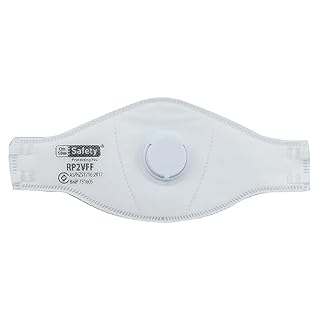
Disposable masks are the moulded cups or flat-folds with a couple of straps, often with a little one-way valve on the front to stop them steaming up. Buy the ones marked P2 and AS/NZS 1716, and skip the flimsy nuisance masks that aren’t rated to anything. They’re cheap, you bin them when they clog, and for the odd afternoon of sanding or sweeping they’re all you need. The valve is worth having — it makes an hour in the mask a lot less sweaty.
Reusable respirators are the rubber half-face type with replaceable cartridges. They cost more up front, and you buy cartridges as they wear out, but the seal is better, they’re comfier over a long stint, and swapping cartridges means one mask covers dust, fumes or both. If your work runs over months of weekends, this is the one that pays off — and it’s a lot less landfill than a bin full of used cups.
A mask only helps if it seals
This is the part people skip, and it’s the whole game. A mask filters the air that passes through it — but air is lazy and takes the easy path, so a gap at the edge is the way in, unfiltered. A perfectly rated P2 with a leak at the cheek is protecting you about as well as an open window.
Two things make the seal. First, fit: the mask has to match the shape of your face, so press the metal nose clip down over the bridge and feel the edges pull in when you breathe in. If they don’t, try a different size or shape. Second, and there’s no polite way round it — facial hair breaks the seal. Stubble and beards leave gaps a mask can’t close, and no amount of strap tension fixes it. If you’re not shaving for the job, the tight-fitting masks in this guide can’t do their job, and the answer is a powered hood-type unit — a different spend for a different day.
Which mask for which job
The quick version, lightest job to worst:
- Sweeping up, sanding timber, cutting untreated wood: a P2 disposable is plenty. P1 will do for light, occasional work, but P2 costs about the same and covers more, so start there.
- MDF, plaster, cement sheet, concrete, brick, tile, grinding metal: P2 minimum, and a reusable is the nicer tool if you’re doing much of it. This is the fine-dust and silica end — don’t tackle it in a nuisance mask.
- Paint, solvent, staining: a plain dust mask does nothing here — you need the vapour cartridge. A reusable with a combined cartridge is the simplest way to cover a job that’s both dust and fumes. One exception: spraying two-pack (isocyanate) paint needs an air-supplied respirator, not a cartridge — the isocyanate gives almost no smell warning and can permanently sensitise your lungs, so even a good vapour cartridge isn’t enough (WorkSafe).
- Anything that might be asbestos: stop. Fibro sheet, old vinyl, textured ceilings and pipe lagging in houses built before the late 1980s can contain it, and it is not a dust-mask job. Get it identified first, and if it is asbestos, use a licensed removalist — it’s licensed work for good reason.
Then add a bit of airflow on top of the mask: cut outside where you can, hook the vacuum to the tool if it has a dust port, and let the fine haze settle before you pull the mask off. The two worst offenders for it — the angle grinder and the circular saw — throw the finest, fastest dust of anything in the shed, and each has its own guide worth a read before you start. Treat the mask as your last line of defence, and the airflow as the first.