

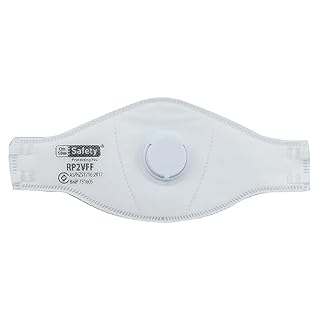


1. On Site Safety P2 Flat Fold Valved Mask — the one to reach for
This is the one we’d hand most people. It’s a P2 mask from an Australian safety brand — P2 is the particulate class on the AS/NZS 1716 scale, the rating that stops the fine dust your nose can’t catch on its own. The mask folds flat into three panels, so it sits in a pocket or a toolbox drawer without getting crushed, and twin elasticised straps pull it in over a range of face shapes.
The reason it wins is the valve. An exhalation valve is a one-way flap that lets your warm breath straight out, so an hour in the mask stays far less sweaty. This one channels that breath downward, away from your eyes, so your safety glasses stay clear. Fogged glasses are why people push a mask down to see — and a mask pulled off your face filters nothing. Matt rates the fold-flat storage; Joel’s point is blunter — the mask that keeps your glasses clear is the mask you’ll keep on your face, and that’s most of the job. If you wear eye protection when there’s dust flying, and you should, start here.
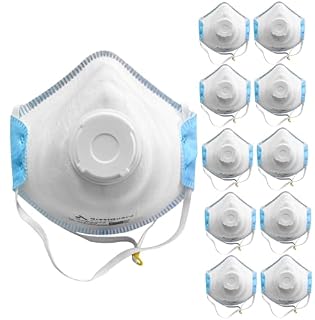
2. SuperShield P2 Valved Dust Mask — the everyday cup
This is the shape most people picture when you say “dust mask” — the moulded cup, a rigid dome that holds a breathing gap between the filter and your mouth so it never collapses against your lips. It’s certified to AS/NZS 1716, carries the same valve for comfort, and has a pre-formed nose bridge to help it seal along the top where leaks usually start. Of the two valved masks here it’s the cheaper per mask, which is why it lands as the value pick.
The cup earns its keep on general shed work: sanding, sweeping up, cutting timber, the odd bit of masonry. Joel likes that the dome shape seals cleanly on an average face without much fiddling. Matt’s one gripe is storage — a moulded cup won’t fold down, so a box of them takes up more room than the flat-folds and a loose one rattling around a toolbox can get knocked out of shape. If you want a no-fuss, AS/NZS-rated mask for everyday dust and don’t care about packing it flat, this is the sensible buy.
3. GIKO P2 Mask 50-Pack — for stocking up
Fifty masks to a box, certified to AS/NZS 1716:2012, and the lowest cost per mask on this page by a wide margin. These use head-bands — elastic that runs over the top of your head — which spreads the pressure and saves the ear-ache you get from ear-loop masks over a long day. They’re an unvalved design, so they’re the plain filtering type with no flap on the front.
That missing valve is the trade-off. With no vent, your breath stays in the mask, so it runs warmer over a long stint and it’s more likely to fog your glasses than the two valved picks above. What you get for that is volume: at fifty a box you can bin a clogged mask every hour of a big sanding job and not think about the cost, and there are always spares for whoever turns up without one. Matt’s line is that a once-a-year hobbyist will have these ageing in the drawer long before they’re used up; Joel counters that for anyone mid-reno, a fifty-box is the reason you never skip the mask because you’ve run out. For high-turnover dusty work, it’s the one to keep on the shelf.
What “P2” means and getting a seal
The P numbers are the AS/NZS 1716 particulate scale: P1 catches coarse dust, P2 adds the fine stuff, and P3 is the high-filtration level. For DIY, P2 is all you need and all a disposable can give you — it handles wood dust, plaster, concrete and silica. P3 exists, but it only works on a full-face respirator, so no disposable mask can deliver it. On the box, the stamp that settles it is AS/NZS 1716, and all three name it. One honest caveat: On Site Safety is an established Australian safety brand, while SuperShield and GIKO are lesser-known makers whose AS/NZS 1716 claim rests on their own listing rather than an independent certificate you can look up. For a weekend of dust that’s a fair risk at the price — but if you want the certainty of a known brand standing behind the rating, the On Site Safety pick is the one worth paying a little more for.
The rating only means something if the mask seals. Fine dust takes the path of least resistance, so a gap at the nose or cheek lets it slide straight past the filter you paid for. Pinch the nose clip down over the bridge, run one strap above your ears and one below, then breathe in — the mask should pull in slightly against your face, which tells you it’s sealed. Stubble is the quiet killer here — even a day’s growth breaks the seal along the jaw, which is one reason a lot of tradies stay clean-shaven. A valve is there for comfort; it doesn’t change what the mask filters, and a fogged-up mask you’ve pulled under your chin filters nothing at all. Our dust masks and respirators guide walks through which mask suits which job in more detail, and WorkSafe’s silica basics spell out why the fine dust from concrete, brick and tile is the part worth covering up for.
There is one dust a P2 disposable is not for, whatever a box or a listing might claim: asbestos. Anything in a pre-1990 home that could be asbestos — old fibro sheeting, eaves, textured ceilings, vinyl backing — is not a dust-mask job at all. Stop, get it identified, and use a licensed removalist. These masks are for everyday nuisance and silica dust, not asbestos fibres.
Don’t go looking for a warranty on any of these. A disposable mask is a consumable, made to be used up and binned, so a guarantee on one makes as much sense as one on a sheet of sandpaper. The exception is a dud box — masks that turn up with snapped straps, a torn filter or a valve that won’t sit. That’s a fault, not fair wear, and the ACCC’s consumer guarantees mean you may be entitled to a replacement or refund, so keep the receipt.
One more thing on where a disposable stops. If you’re in dust all day, or the job throws fumes as well — paint, solvent, glue — a disposable dust filter isn’t enough, because it stops particles but does nothing for vapour. That’s the point you step up to a reusable half-face respirator with twist-on cartridges, like the 3M reusable respirator we cover separately. For dust alone, on the odd afternoon or a weekend of sanding, a P2 disposable is all you need.
The verdict
You wear safety glasses, or you’re in dust regularly: the On Site Safety flat-fold. The downflow valve keeps your glasses clear and the mask on your face, which is the whole battle, and it folds flat to carry.
You want a cheap, AS/NZS-rated cup for the odd job: the SuperShield moulded cup. Same P2 protection and the same valve for less per mask — it just won’t pack down flat.
You get through a lot of masks: the GIKO fifty-box. No valve, so it runs warmer, but the per-mask cost is the lowest here and you’ll always have a spare for the job or the mate who forgot one.
And if the job is all-day dust or fumes as well as dust, none of these is the answer — that’s when you move up to a reusable respirator with cartridges. For everything short of that, match the mask to how much dusty work you do, get it sealed at the nose, and a P2 disposable does the quiet job of keeping the fine stuff out of your lungs.