
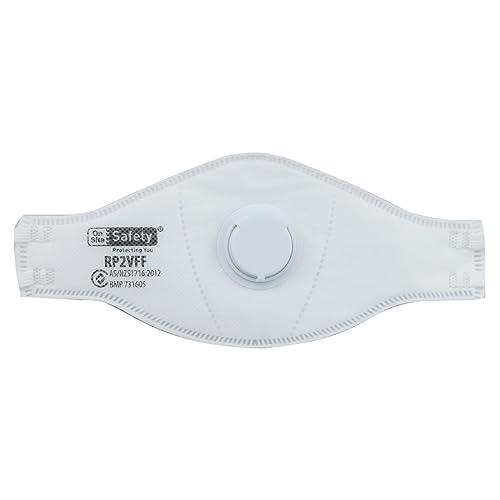
The rating on a dust mask is only worth as much as the brand behind it. Search “P2 dust mask” on Amazon and you get a wall of near-identical boxes, most from makers you’ll never find again, each printing AS/NZS 1716 on the packaging on their own say-so. On Site Safety is a genuine Australian safety supplier, and that’s the reason this one leads: the P2 rating is one you can actually stand behind rather than take on trust.
The mask itself is a flat-fold: a three-panel design that opens into a cup over your nose and mouth, then folds flat again for storage. That matters more than it sounds. A moulded cup mask hogs space in a box and gets knocked out of shape rattling around a toolbox; a flat-fold slips into a drawer, a glovebox or a jacket pocket and is still the right shape when you pull it out. Each one is sealed individually, so a mask you stashed six months ago is clean when you need it.
There’s an exhalation valve on the front, a small one-way flap that lets your breath out without pushing it back through the filter. It runs cooler over a long stint and fogs your glasses less, which is the difference between wearing the mask for a whole sanding job and pulling it under your chin halfway through. Worth being clear on what the valve does and doesn’t do: it’s there for comfort, and it changes nothing about what the mask filters. It also vents your unfiltered breath outward, so a valved mask isn’t the one for protecting other people. For keeping dust out of your lungs, which is the job here, it’s all upside.
Like any disposable, it only works if it seals. Pinch the nose clip down over the bridge, run one strap above your ears and one below, and breathe in. The mask should pull in slightly against your face. A day’s stubble breaks that seal along the jaw no matter how good the mask is, which is the usual reason a mask that should work doesn’t. Get the seal right and a P2 handles the everyday shed list: wood dust, plaster, MDF, and the fine crystalline silica thrown off cutting concrete, brick and pavers that’s the part quietly worth covering up for.
Two limits are worth naming. A P2 disposable stops particles and does nothing for fumes or vapours — paint, solvent, glue — so if your job throws those, you step up to a reusable half-face respirator with cartridges. And whatever any listing claims, no disposable mask is for asbestos: anything in a pre-1990 home that might be asbestos is a stop-and-call-a-licensed-removalist job, not a dust-mask one.
If you want the full rundown of P1, P2 and P3 ratings and where a disposable stops, our dust masks and respirators guide walks through it, and the full P2 disposable roundup ranks this one against the cheaper generic boxes. For dust alone, on the odd afternoon or a weekend of sanding, this is the disposable I’d reach for first, because the small premium buys a rating you don’t have to take on faith.
Specifications
- Type
- P2 disposable flat-fold respirator, valved
- Rated to
- AS/NZS 1716 P2 — genuine, known AU brand
- Pack
- 10 masks
- Valve
- Exhalation valve — comfort only, no change to filtering
- Best for
- Wood, plaster, concrete and silica dust
- Not for
- Paint fumes, solvents or asbestos