



1. Bosch 7-Piece Masonry Set — the everyday set
This is the set to leave in the drawer. Most masonry drilling a DIYer does is a plug hole in brick or block — hanging a shelf, a TV bracket, a hose reel — and that job wants a 5, 6, 7 or 8mm bit — the common wall-plug sizes, and the bigger half of this set. Each bit has a carbide tip, the hard tungsten-carbide edge brazed to the end that chips through stone where a plain steel bit would just polish it. Run it in the drill’s hammer mode and a hole that felt impossible with a timber bit starts in seconds.
It’s the cheapest of the three, and that’s the point of it. Bits wear out and snap, so a set you can replace without thinking beats a premium set you baby. Bosch rates these for brick, block and soft stone, which stops short of hard concrete but covers the bulk of DIY work. Matt would keep a cheap set like this for the odd bracket rather than lock up money in a premium one; Joel’d sooner own a masonry set he can wear out without a second thought. The set struggles on a slab or dense aggregate concrete: the tips wear fast and drilling crawls. For that, spend up. For everything short of it, this is the set to buy first.
2. DeWalt DW5207 Percussion Set — concrete and heavy drilling
Concrete is where a cheap set gives up and a percussion set earns its money. Percussion bits are built to survive the hammering, with a stronger carbide tip and a body that takes the pounding of a hammer drill without the tip working loose. Where the Bosch stops at 8mm, this DeWalt set runs to a 1/2-inch bit, so it covers the bigger anchor bolts and masonry screws that hold something structural to a slab or a besser-block wall (a besser block is a hollow concrete building block). Its bits are sized in imperial — 3/16 to 1/2 inch, roughly 5 to 13mm — so check each size against the metric plug or anchor you’re fitting.
It’s dearer, and it should be, but the value is in what it does that a budget set can’t: keep drilling clean holes in hard concrete without the tips rounding off after a handful. If your job is a few plugs in brick a year, it’s more set than you need. The Bosch does that for a fraction of the money. If you’re anchoring a pergola post, a water tank stand or a run of hardware into concrete, this is the set that gets through it. Matt rates the wider size spread for anchor work; Joel’s line is that it’s the set to own if you drill concrete more than once in a blue moon. Past this point, no bit does more. The next step up is a different drill, which we get to below.
3. Milwaukee Multi-Material 8-Piece — one bit for mixed jobs
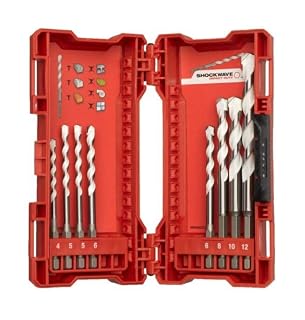
Some holes run through more than one material. A fixing in a tiled bathroom wall means tile, then adhesive, then the brick behind it; a hole for a cable might catch a bit of steel on the way. Swap bits for each layer and it’s slow going. Milwaukee’s multi-material bits carry a two-cutter carbide tip rated to drill masonry, tile, thin metal, timber and more with the one bit, so you line the hole up once and go straight through.
The trade-off is that a do-everything bit isn’t the sharpest tool for any single one. In a wall of plain brick, the cheaper Bosch drills just as many holes for less. These earn their place when the wall is layered or you don’t know what’s behind the surface. They run a 1/4-inch hex shank instead of a round one. That locks straight into a quick-change chuck or an impact driver, and it seats in a normal drill chuck just as well. Drop the drill into hammer mode for the masonry layers and leave it off for the tile and metal. Matt would reach for these on bathroom and kitchen fixings where tile meets brick; Joel’s take is that if you only ever drill plain brick, you don’t need them — but the first time a bit skates across a tile, you’ll want one.
Which bits fit your drill?
Fitment for a masonry set comes down to the shank and the hammer setting. The shank is the plain end that grips in the chuck. All three sets here have a round or hex shank that seats in a standard three-jaw chuck, so they fit the cordless drill or hammer drill most DIYers own. What they are not is SDS. SDS-plus is a different fitting: a splined shank that clicks into a rotary hammer, a heavier drill built for solid concrete all day. If your drill’s chuck opens and closes on a key or a twist of the collar, it’s not SDS, and these are the bits for it.
The second thing is hammer mode. A masonry bit works by chipping the stone, so it needs the drill to punch as it turns. That’s the “hammer” symbol on the mode collar, next to the drill and screwdriver icons. Switch to it for masonry and the bit bites; leave it on plain drill for tile and metal so you don’t crack the surface. If your drill has no hammer setting at all, a masonry bit will struggle even in brick. That’s the point where a percussion or hammer drill earns its place, and our drill bits guide runs through which bit suits which material. Drilling a slab or hard concrete regularly is the one job that justifies stepping past all three of these to an SDS rotary hammer.
Is there a warranty on masonry bits?
Not one you’d ever claim on. A masonry bit is a wear item: the carbide tip rounds off a little with every hole it grinds through stone, so a set that’s blunt after heavy concrete work has reached the end of its life, plain and simple. The case worth knowing about is a bit that was faulty before you ever started drilling: a tip cracked in the packet, a shank spun off-centre so it wobbles in the chuck, or carbide that breaks up on a hole it should have handled. Australian Consumer Law treats that as a fault, and the ACCC’s consumer guarantees say a faulty product may entitle you to a repair, replacement or refund — worth hanging on to the receipt for a dearer set like the DeWalt. The thing to plan for isn’t the paperwork, it’s the dust: drilling brick and concrete throws out fine crystalline silica dust that’s harmful to breathe, so wear a mask and eye protection, and keep a vacuum near the hole.
The verdict
You drill the odd plug into brick or block: the Bosch 7-piece. It covers the sizes you use most, the carbide tips get through brick and block without fuss, and it’s cheap enough to replace without a second thought — buy it first and only add to it when a job asks for more.
You’re anchoring into concrete: the DeWalt DW5207. The percussion-rated tips keep drilling clean holes in hard concrete where a budget set rounds off, and the bigger sizes cover the anchor bolts that hold something structural down.
You’re drilling layered walls — tile over brick, or an unknown surface: the Milwaukee multi-material set. One bit goes through tile, masonry and thin metal without a swap, which is worth the extra on a bathroom or kitchen fixing even if it’s dearer per hole in plain brick.
The Bosch set covers most of what a DIYer drills; the other two come out for the jobs it can’t handle. Match the bit to the wall, put the drill in hammer mode for masonry, and the drill you already own will get through brick, block and concrete — you just fit the set that suits the hole.