



1. Bosch 2609255588 Tile Drill Bit Set — the everyday screw-hole set
This is the set for the job most people have on their hands: a few holes in a tiled wall to hang a towel rail, a mirror or a bathroom cabinet. The three sizes, 5, 6 and 8mm, are the common wall-plug sizes, so it covers the fixings you’ll fit without a bit you never touch. Each tip is a diamond-ground spear point, a hard sharpened edge that bites into the glaze and starts the hole where a blunt tip would wander across it and crack the tile. Bosch rates them to run at low speed and without hammer, which is what a tile wants.
It’s the cheapest way to get a trusted brand on the one job where a slipping bit cracks the tile. Three bits is a narrow range. There are no big holes here and nothing under 5mm, so treat it as a fixings set and keep the larger jobs for another tool. On dense porcelain it will still drill, though it slows down and the tip won’t last as many holes as a diamond bit would. Matt would keep a small branded set like this on hand for the odd bathroom fixing; Joel’s take is that at this price you buy it, wear it out on a reno, and buy it again without thinking twice. For screw holes in wall tiles, start here.
2. Milwaukee Diamond Plus Hole Saw Set — clean round holes in hard porcelain
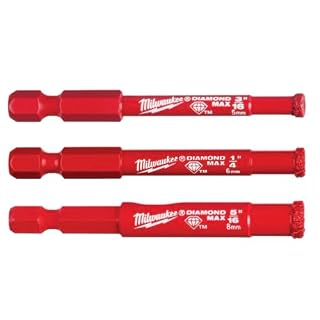
Some tile holes are too big for a spear-point bit, like a hole to pass a pipe, a cable or a fitting through the wall. That’s a hole saw’s job: a cylinder that cuts a clean round disc out of the tile. Milwaukee’s Diamond Plus hole saws carry a diamond-coated rim rated for hard porcelain, natural stone like granite, and glass, the surfaces a toothed hole saw would chip and a carbide bit would give up on. Diamond doesn’t cut by biting the way a tooth does; the grit grinds its way through, which is what a hard porcelain or stone tile needs.
This is the priciest pick and the most specialised: three sizes, all for round clearance holes, and none of them a screw-hole bit. If your reno has no pipe or cable passing through a tiled wall, you don’t need it. When it does, a diamond rim is what gets through porcelain or stone without cracking it, and it holds an edge on that surface far longer than carbide. One thing to know: Milwaukee is a TTi brand, and its manufacturer warranty isn’t offered on marketplace purchases. A hole saw is a wear item you use up, so that counts for less here than it would on a tool. Matt would spend up for the diamond rim on porcelain; Joel only when the job calls for a hole that big.
3. KOZTOL Tile & Porcelain Bit Set — the budget kit with more sizes
Where the Bosch gives you three sizes, this budget set spreads from 3mm up to 12mm, so it covers small holes for picture screws through to a fatter plug. That helps when you’re not sure what size fixing the job needs. The tips are tungsten carbide ground to a spear point, the same idea as the Bosch: a sharp point that grips the glaze and starts the hole. They run on a 1/4-inch hex shank, so they lock straight into a quick-change chuck or a drill.
The catch with a cheap set is consistency. Carbide spear points handle ceramic and softer glazed tiles well, but on hard porcelain they slow right down and the tip dulls faster than a diamond bit, so take it easy, keep it cool, and expect to replace them sooner. For a one-off reno on ordinary wall tiles, that’s a fair trade for the price and the size range. Matt would still reach for the branded set on porcelain; Joel’s line is that for a weekend of hanging things on ceramic, a cheap kit with every size in it beats paying more for three. Buy it for the range and the price; it won’t outlast a diamond bit.
How to drill tile without cracking it
The tile survives or cracks in the first few seconds, before the bit is even through the glaze. Three things get you there. First, no hammer. A masonry bit works by hammering, and hammering is what shatters a tile — keep the drill in plain rotary mode, the setting marked with just the drill symbol. Second, stop the bit skating. A tip skidding across the glaze scratches it and starts nowhere, so put a strip of masking tape over the spot to give the point something to grip, then start slow with light pressure and let it bite. Third, keep it cool. Friction builds heat, and heat cracks tile and burns the tip, so a dab of water on the hole or a pause to let it cool matters most on hard porcelain and glass. Ease right off as the bit breaks through the back of the tile — the pressure that got you through is the pressure that cracks it on the way out. Once you’re through the tile you’re into the wall behind, usually brick or block, which is a different bit again. Our drill bits guide covers which bit suits which material, and if the wall behind is masonry, a masonry set picks up where the tile bit stops.
Do tile bits come with a warranty?
Think of a tile bit the way you’d think of sandpaper. It wears out by design; every hole takes a little edge off the tip, and a blunt set at the end of a reno has earned its keep, not failed. So there’s no warranty here in the sense you’d want on a drill. What you can act on is a dud out of the box: a tip that arrives cracked, or one that crumbles on a hole it was rated for. That counts as a fault, and the ACCC’s consumer guarantees note that a faulty product may leave you owed a repair, replacement or refund, so keep the receipt on the dearer sets. Otherwise the reason to pick each one has nothing to do with paperwork: the Bosch for a tip you can rely on, the Milwaukee for diamond that gets through porcelain, the budget set for cheap coverage across the sizes.
The verdict
You’re hanging things on a tiled wall — a towel rail, a mirror, a cabinet: the Bosch set. The 5–8mm sizes are the common wall plugs, the diamond-ground tips start cleanly instead of skating, and it’s cheap enough not to baby.
You need a big round hole through tile — for a pipe, a cable or a fitting: the Milwaukee Diamond Plus hole saws. A diamond rim is what gets through hard porcelain or stone without cracking it, and no spear-point bit will cut a hole that size.
You want every size on a budget, and the tiles are ordinary ceramic: the KOZTOL set. It spreads from 3 to 12mm for less than the branded three-piece, as long as you take it slow and don’t expect it to last on porcelain.