




1. Milwaukee The Ax Demolition Blades — the everyday reno cut
This is the blade that lives in the saw through most of a reno. A demolition blade is built for the messy cut — timber studs, old framing, pallet wood, and the nail or screw you didn’t see coming. The Ax is a bi-metal blade, which means a spring-steel body with harder high-speed-steel teeth welded along the edge: the teeth stay hard where they need to be, the body takes the flexing. Milwaukee builds this one thick and stiff, so it tracks straight instead of wandering when you lean on it. At 5 TPI — teeth per inch, so fewer and bigger teeth for a fast, aggressive cut — it tears through wood quickly, and those bi-metal teeth survive an embedded nail that would strip an all-hardened blade. At 230mm it’s long enough to cut through a stud in one pass.
Neither of us runs Milwaukee as our main platform, but The Ax is built for exactly this job: an aggressive tooth pattern and bi-metal teeth that keep biting after a cheap all-steel blade would have rounded off on the first buried nail. Five in the pack is enough spares to see out a day of demolition work. Matt’s note: for clean, splinter-free cuts in finished timber you want a higher tooth count than this — it’s built to demolish, so it leaves a rough edge behind it. On the universal half-inch tang it seats in almost any reciprocating saw, so buy this one first.
2. Starrett Bi-Metal Metal Blades — for rod, bolts and angle
When the cut turns to metal, the demolition blade is the wrong tool — its big, widely spaced teeth catch and skip on steel instead of cutting it. A metal blade runs the opposite way: fine teeth, packed close. The rule with metal is to keep at least three teeth touching the material at once. With too few, they snag and tear thin steel instead of slicing it, so the thinner the steel, the finer the blade you want. These Starrett blades are 14 TPI, which puts the teeth about 1.8mm apart — three of them in the cut once the steel is around 5mm thick or more. That is threaded rod, a seized bolt, light angle iron, solid stock; Starrett rates them for material 6mm to 25mm. Thin-wall pipe and electrical conduit sit at the other end of the scale and want a finer blade again, 18 to 24 TPI. These are bi-metal too, so the teeth take the heat of cutting steel without going blunt in one job.
At 150mm they’re shorter than the demolition blade, which is what you want on metal — less blade flapping around outside the cut and more control. The five-pack matters more here than anywhere: metal blunts teeth faster than wood, so you’ll work through these, and buying singles for metal gets expensive fast. Matt would add a smear of cutting paste for anything thick — it keeps the teeth cool and extends blade life. On light bolt and rod work you can skip it. They clip into the same universal tang as the rest.
3. WORKPRO Pruning Blades — for green branches and the garden
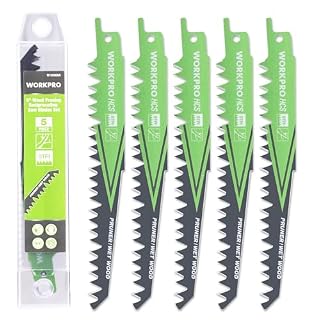
Cutting living wood is its own problem. Green branches are wet and fibrous, and they clog an ordinary wood blade — the damp sawdust packs into the gullets, the gaps between the teeth, and the blade stops cutting and starts burning. A pruning blade fixes that with big, deep, widely set teeth that clear the wet chips as they go. These WORKPRO blades are 150mm and run a coarse 5 TPI with that open tooth set, and WORKPRO rates them for branches up to about 100mm thick. Clip one into a reciprocating saw and it turns into a powered pruning saw.
They use plain high-carbon steel, which is the right call for a pruning blade — a flexible, sharp all-steel blade cuts green wood well and costs little, and pruning doesn’t punish teeth the way nail-hitting or metal does. That does mean they’re the wrong blade for dry, seasoned hardwood or anything with a hidden nail, where they’ll dull faster than the demolition pack. Joel’s note: keep them away from the demolition pile — one buried nail is enough to take the edge off a set. Same universal tang, so they clip into the saw you already own.
Tangs, length and TPI — matching the blade to the cut
Three things decide whether a blade suits the cut, and none of them is the brand on it. The first is the tang — the flat end that clips into the saw. Nearly every reciprocating saw sold here, cordless or corded, takes the universal half-inch tang, and all three blades on this page use it, so they seat in any common saw with the tool-free clamp. If you’re still choosing the saw, the jigsaw blade guide and circular saw blade roundup round out the rest of a cutting kit.
The second is length. A blade needs to be longer than the material is thick, with enough left over that the tip clears the far side on every stroke — a blade that’s too short bottoms out and stops cutting. A 150mm blade covers rod, bolts and branch work; a 230mm blade like The Ax reaches through a 90mm stud or a fence post with room to spare. The third is TPI, and it runs opposite for wood and metal: low TPI (5–6) means big teeth and a fast, rough cut for timber and branches; high TPI (14–18) means fine teeth and a slow, clean cut for metal. Match those three and the cut sorts itself out.
One safety note the blade won’t give you: before you plunge into a wall or floor, know what’s behind it. A reciprocating saw will cut straight through a live cable or a water pipe without slowing down, so check for services first, and let the blade come to a stop before you pull it out of the cut.
Blades wear out — that is the job. They flex hard on every stroke, and one that goes blunt or finally snaps after a decent stretch of work has done what it was built to do. Worth knowing where that line sits, though. Teeth missing straight out of the packet, or a break on the first easy cut, is a different thing: the blade was faulty before you started. The ACCC’s consumer guarantees cover goods that aren’t of acceptable quality, so keep the receipt and take it up with the seller.
The verdict
You’re pulling apart a deck, a wall or old framing: the Milwaukee Ax. It keeps cutting through nail-embedded timber long after a cheap blade has rounded off — the one to load first.
You’re cutting threaded rod, bolts or angle: the Starrett bi-metal 14 TPI. Fine teeth that cut steel clean where the demolition blade skips, and five in the pack, because metal eats blades.
You’re clearing branches and green limbs: the WORKPRO pruning blades. The cheapest here, with coarse teeth that clear wet chips instead of clogging, turning the saw into a fast pruning saw.
Most sheds want the demolition blade in the saw and the other two in the case for when the job changes.