



1. HORUSDY 6-Pack Wood Clamp Set — the versatile starter set
This is the set that does the most for the least, which is why it leads. You get four bar clamps, two at 6 inches (150 mm) and two at 12 inches (305 mm), plus a pair of small spring clamps, which is the six the pack name counts. The short pair handles drawer boxes and narrow rails; the 12-inch pair spans a face frame or a small box. Note the ceiling: 305 mm is the widest it opens, so a full tabletop panel is beyond this set. Each one ratchets shut with a trigger and holds up to 150 lb of pressure, plenty for edge-gluing boards or pulling a mitre tight while the glue grabs.
The clever bit is the quick-change jaws: press the button, reverse the sliding jaw, and the clamp becomes a spreader that pushes apart instead of together — handy for easing a dry-fitted joint back open, or freeing a shelf that’s gone in too tight. For a first clamp set this is the sensible starting point: two useful lengths, and enough of them to get a small glue-up done instead of running short halfway. Matt would point out that the nylon bodies and plain finish give away the budget price. For the money, neither of us minds. It’s the versatile core of a DIY clamp drawer, and the one to buy first.
2. Irwin QUICK-GRIP One-Handed Bar Clamp 4-Pack — the set that outlives the project
Both of the bar-clamp sets here work off a one-hand trigger, so that isn’t what separates them. What you’re paying Irwin for is the build and what stands behind it. The body is resin over a hardened steel bar, rated to 140 lb of clamping force, a shade under the budget set’s 150 lb. The difference shows over time rather than on the first glue-up: Irwin warrants these for as long as the original purchaser owns them, against defects in material and workmanship. On a tool with a moving trigger and a sliding jaw, that is worth more than the extra squeeze would be.
You get four of them, all 6-inch, and that is the catch. This is a set of short clamps for narrow work: drawer boxes, face frames, small repairs. It won’t reach across a benchtop. Joel’s push-back is the price, since four short clamps cost more than the six-pack above, so they earn their place as the set you add second rather than the one you start with. What they’re for is the work you’ll still be doing in ten years.
3. WORKPRO 20-Piece Spring Clamp Set — light holds and jigs
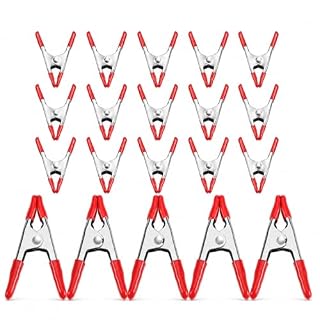
Forget glue-ups under real pressure — these are the cheap, grab-anywhere clamps that do the hundred small holds a project throws up. A spring clamp is exactly what it sounds like: a big spring-loaded peg you squeeze open and let snap shut. There are twenty in the set — fifteen with a small 19 mm jaw and five with a wider 25 mm one — so you’re never hunting for a free clamp when you just need to pin a fence to the bench or hold a template while you rout.
The PVC-coated tips don’t mark the timber, which matters when you’re clamping a finished face, and the light spring pressure that makes them useless for edge-gluing is exactly what you want for holding a workpiece against a stop without denting it. Matt’s only note is to keep them in their lane: hand-spring pressure, not real clamping force. Reach for a bar clamp the moment a joint has to be pulled tight and held. For everything lighter, twenty of them for pocket money is an easy call.
How many clamps you need, and which
The short answer from both of us: more than you think, and in more than one size. The old line that you can never own enough clamps isn’t really a joke — a single panel glue-up can swallow six on its own, alternating top and bottom to pull the boards flat, and they need to be long enough to span the panel. Start with a set of bar clamps in two lengths, because jaw opening, the widest gap the clamp will take, decides what you can glue. A 6-inch clamp is fine for a drawer side. A wide tabletop wants something that spans it, which means clamps well past anything on this page.
After that it’s about matching the clamp to the pressure. Bar and F-clamps (the F is just the shape — a fixed jaw at the top of the bar, a sliding one below) put real squeeze on a joint and hold it flat while the glue cures. Spring clamps do the opposite job: near-zero setup, light pressure, for the quick holds where you only need something to stay put. A drawer of both covers the range — the heavy clamps for the joints that carry the load, the spring clamps for everything you’re holding for a minute.
One more thing worth knowing: the clamp only does half the work. Glue needs the two faces flat and clean to bond, so a clamp that pulls a slightly bowed board straight is doing real work, while one crushing a sloppy joint just squeezes the glue out. When you’re screwing parts together instead of gluing them, a clamp holds them aligned while you drive the fastener — our drill vs impact driver guide covers which tool to reach for there.
The catch on warranty
Warranties on clamps vary more than you would expect. Irwin covers these for as long as the original purchaser owns them against defects in material and workmanship, which is the strongest cover on this page and part of what the price buys. HORUSDY states 12 months. We could find no published warranty position for the WORKPRO set, which is not the same as there being none. Whatever the maker offers, the backstop is the same one that covers any tool. Under Australian Consumer Law you may be entitled to a repair, replacement or refund if a tool fails to be of acceptable quality, whoever you bought it from, so keep the receipt — the ACCC’s guidance on consumer guarantees sets out where you stand.
The verdict
Building your first clamp collection: the HORUSDY six-pack. Two useful bar lengths, a spreader function thrown in, and a pair of spring clamps: the most capability for the money, and the one to start with.
You glue up on your own: add the Irwin one-handed quick clamps. Working a clamp with one hand while the other keeps the parts lined up earns the extra outlay the moment you’re doing it solo.
You just need light holds: the WORKPRO spring-clamp twenty-pack. Not for pulling joints tight, but hard to beat for the constant small holds — pinning a stop, holding a template, clipping a fence to the bench.
Most sheds want the bar clamps first, the spring clamps close behind for the light stuff, and the one-handed set added when solo assembly starts to wear thin. Buy in twos and threes as the projects demand — the drawer fills up faster than you’d think, and you’ll find a use for every one.